
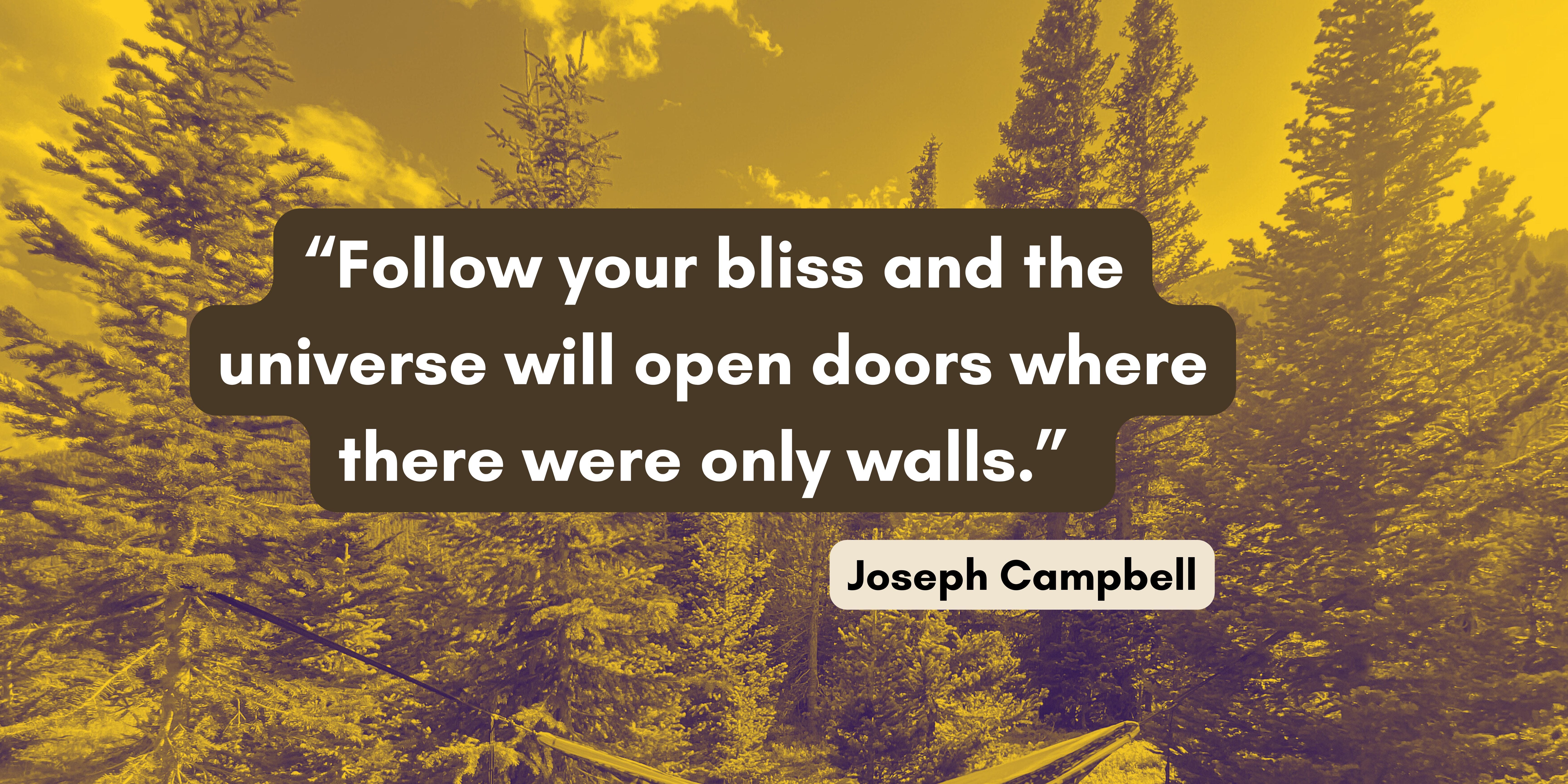
Joseph Campbell, famed mythologist, may be most famous for his edict: “follow your bliss.” He ensures readers, students, and listeners (in a manner reminiscent of Paulo Coelho’s The Alchemist) that if one follows their dreams, the universe will conspire in their favor.
A life where one fulfills their responsibilities, and not their hero’s quest, is a life wasted.
Campbell explains, “...If you do follow your bliss, you put yourself on a kind of track that has been there all the while, waiting for you, and the life that you ought to be living is the one you’re living somehow. And well, you can see it. You begin to deal with people who are in the field of your bliss, and they open doors to you. I say, follow your bliss, and don’t be afraid, and doors will open where you didn’t know they were going to be.”
I’ve had my own life transformed by this modality.
I learned to seek, instead of merely survive early motherhood and the trenches of public school teaching. And, yes, as Campbell promised: the universe has conspired in my favor. There are invisible (and visible) helping hands guiding me as I edit my fourth complete manuscript. As my first story, Eve, makes her way into the world.
Sinclair Lewis’ Babbitt, in the last line of the satirical novel, confesses: “I’ve never done a thing I wanted to in all my life.”
Campbell asks, “What kind of life was it, what good is it? You’ve never done a thing you wanted to in all your life.”
Babbitt, like many, sleepwalked through his own life, only doing what he was told to do. Only fulfilling his responsibilities. He was deadened by conformity, shoulds, and social scripts. He neglected his inner call.
Which is a shame. But could Babbitt stop showing up to work? Fail to pay his bills—without causing harm to those who relied on him?
I found myself wondering…what happens when following your own bliss impedes the bliss of another?
Joseph Campbell’s “follow your bliss” can be oversimplified in this way. It’s important we understand that “follow your bliss” does not mean “do whatever feels good to me,” despite the cost. What Campbell means is closer to: a deep sense of alignment with your true vocation, the feeling that your life is something meaningful. That you’re doing what makes you feel alive.
Mythic heroes don’t just chase pleasure; they accept limits, sacrifices, and obligations.
If “bliss” means pleasure regardless of impact, then it’s not Campbell. If the myths teach us anything, it’s that human lives are interdependent. Marriage, parenting, friendship, and community all impose ethical constraints.
Following your bliss becomes dangerous when it’s used to justify harm, dangerous when it ignores consent and consequence. When it replaces ethical responsibility with “authenticity.”
Campbell knew this. Bliss doesn’t mean acting on every desire. It means living in integrity within one’s chosen myth. Bliss is not desire; bliss is following the path that makes you more whole, even when it costs you something.
Campbell uses Nietzsche’s Thus Spoke Zarathustra to explain:
“When you are a child, when you are young and a young person, you are a camel. The camel gets down on its knees and says, ‘Put a load on me.’ This is obedience. This is receiving the instruction, information that your society knows you must have in order to live a competent life. When the camel is well loaded, he gets up on his feet, struggles to his feet, and runs out into the desert, where he becomes transformed into a lion. The heavier the load, the more powerful the lion…”
Nietzsche describes a spirit’s transformation as a three-stage process: the camel, the lion, and the child.
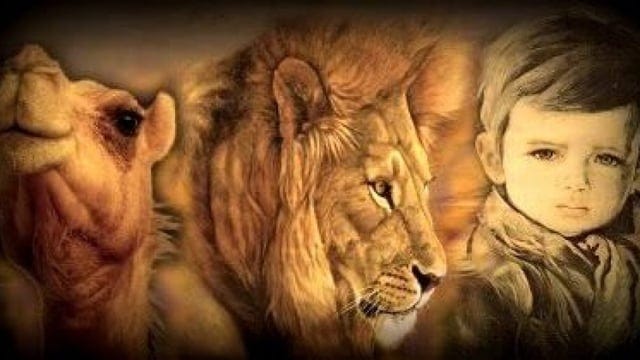
The Camel is burden, discipline, a test of strength. Traditions and obligations that shape us. Marriage vows, philosophical systems, religious practices, social responsibility. The camel phase builds strength, learns limits, develops depth, acquires language for meaning, and understands why rules exist. Without the camel stage, any rebellion is shallow freedom—naive, dangerous desire. Nietzsche does not mock the camel. He honors the camel.
The lion comes next. The lion says, “No.” The lion slays inherited commandments. The lion bares her teeth at contrived, manipulative social structures built to oppress us.
But, notice: The lion knows what it is rejecting because it carried it first. This is the difference between responsible rebellion and shallow pleasure-seeking: The lion’s freedom is earned. Without the camel, “bliss” can be indulgent and even harmful.
Campbell explains that the lion finds a deeper, truer way to live instead: “The function of the lion is to kill a dragon, and the name of the dragon is “Thou Shalt.” And on every scale of the dragon there is a “Thou Shalt” imprinted. Some of it comes from 2,000 years, 4,000 years ago.”
The last transformation is the lion to the child. The child is play, after discipline. Creativity after mastery. You learned the rules first, the myths, the philosophies…Then, you can responsibly break them.
In myth, the hero leaves the village (lion) but returns with a “boon” (child) transformed. A child finds a creative, truthful way forward, maybe recommitment, renegotiation, or a parting with old ways and beliefs, but never deception. The camel is beautiful because it makes depth possible.
In my novel, Eve, the first woman is not naive or merely tempted. Instead, she carries the weight first. She learns what obedience feels like (the camel), what harmony costs, what “goodness” conceals. Then, she asks, “Why must it be so?” Eve eats knowingly—the lion’s courage. She recognizes that while Adam is oriented toward Eden, she is oriented toward the world. The lion refuses to live a lie. Eve says: “I cannot remain where I am no longer becoming.” As a child, Eve consciously creates meaning rather than inheriting it. Eve’s boon is: consciousness, eros, choice.
Campbell explains, “I mean, you’ve got to learn to recognize your own depths.”