In the 17th-century epic poem Paradise Lost, John Milton sets out to justify “the ways of God to men.”
Yes, Milton specifies “men.” Because that’s how it was in 17th-century England.
Milton’s life and actions as a politician, poet, and civil servant reveal deep adherence to the patriarchal beliefs of his time and place: male dominance; female subservience. At each turn, he repeatedly affirmed male supremacy as divinely ordained.
Yet, Milton seems to, in Paradise Lost, subvert these very same patriarchal ideas in his portrayal of Eve.
Sure, there is much of what you would expect in Milton’s philosophical and theological gender oppression throughout the epic poem. However, in my first reading of Paradise Lost, I was shocked, and inspired, by Eve’s humanity. Milton imbues Eve with power, reason, discernment, and proto-feminist autonomy.
I argue that Paradise Lost can be read as a feminist argument. I argue that Milton intentionally portrays Eve as an intellectual heroine whose forbidden bite symbolizes the birth of human consciousness.
Meeting Eve

As Eve is introduced in Book Four of Paradise Lost, Milton asserts (like a devout 17th-century Christian) Eve’s patriarchal oppressions typical of the late Renaissance period in England:
“Not equal, as their sex not equal seemed
For contemplation he and valor formed,
For softness she and sweet attractive grace,
He for God only, she for God in him:
His fair large front and eye sublime declared
Absolute rule…” (Milton 4.295-301).
Milton pronounces males as superior to women in this comparative description of Adam and Eve. Men and women are “Not equal,” as the Bible explicitly states, and Milton, here, reinforces. The male attributes are power (“valor”) and wisdom (“contemplation”); the female attributes are of softness and sweetness (“sweet attractive grace”), prevailing gender stereotypes from Milton’s time. Here, as exegetically presented from scripture, Eve does not have direct access to God, but instead, her access to the divine comes through Adam: “He for God only, she for God in him…”
However, as Milton continues his description of the first man and woman, we encounter Milton’s first contradiction just three lines later:
“She as a veil down to the slender waist
Her unadorned golden tresses wore
Disheveled, but in wanton ringlets waved
As the vine curls her tendrils, which implied
Subjection, but required with gentle sway…” (Milton 4.304-308)
In this simile, Milton seems, at first, to imply Eve’s subjection, like a vine, obeying the matter supporting its climb. Until: “...but in wanton ringlets waved.” Wanton is defined in the Oxford English Dictionary, in its 17th century usage, as disobedience: “…disobedient, unruly; naughty.” Eve’s physicality, up to her tresses, was sculpted by God from Adam’s rib. So if Eve’s curls were wanton, they were made this way, yet she is punished for acting just so.
And is the vine not the living, growing, curling entity? And would not Adam, in the simile, be the rod or object the vine curls around? In the end, as Milton describes, the vine is the autonomous, rebellious entity of the two.
Milton paints Eve as a goddess-like deity. There is power in Eve. Her femininity, and the times, do “imply” subjection, “but” the reader can clearly sense she is capable, and even inclined, to rise with Adam, as a vine, and then perhaps even a continued “sway” above Adam’s rule.
What Milton illuminates, in Eve, is power. Though framed as subjection, as a vine surrounding Adam, Milton clarifies Eve as the autonomous, live force, climbing toward the sun with governance and goddess-like power.
Eve’s Reflection
Later in Book Four, Eve is drawn to herself before she is drawn to Adam. Eve’s reflection, though an allusion to Narcissus and self-centeredness, is presented by Milton as proto-feminist autonomy. Eve, at first, is afraid by her self-awareness because that is also her power:
“Bending to look on me, I started back,
It started back, but pleased I soon returned,” (Milton 4.462-463)
While Eve’s initial reaction is to withdraw from herself, Milton presents another “but.” “But,” pleased, Eve makes the decision to return to herself. She is then rewarded with “answering looks/ of sympathy and love” (Milton 4.464-465). That is, until, Milton introduces a voice, the patriarchy, or God, or some angelic force, persuading her away from her power, her sympathy:
“Had not a voice thus warned me, “What thou seest,
What there thou seest fair creature is thyself,
With thee it comes and goes: but follow me…” (Milton 4.467-469).
Eve is captivated by herself until Adam interrupts. Until this moment, she understands herself, her beauty, and her power as good. Her keen sense of self emerges before the serpent’s arrival, before the Fall. Eve is, as shown in these early lines, imbued with inherent self pleasure, (not some notion of sinful self pleasure later contrived by Lucifer’s persuasion).
***Milton’s use of “pleased” parallels, and foreshadows, the moment Eve takes the fruit in Book Nine: “Thus to herself she pleasingly began” (Milton 9.794).***
This moment of refusal of Adam and return to self, “but pleased I soon returned,” is Eve’s consideration, a woman’s autonomy over blind allegiance. Yet, in this scene, Milton depicts the voice, the patriarchy, drawing Eve away from her own power. Eve flees Adam as Daphne flees Apollo:
“Than that smooth, wat’ry image, back I turned,
Thou following cried’st aloud, ‘Return fair Eve,
Whom fli’st thou? Whom thou fli’st, of him thou art” (Milton 4.480-482).
As Eve turns away from herself, and towards Adam, she recoils. Adam calls after her. She sees him, hears his voice, and desires, instead, escape. In a similar vein, Apollo, god of prophecy, sees Daphne, and he, like Adam, is instantly attracted. Apollo pursues her, and Daphne, like Eve, flees. As Apollo gains on Daphne, she cries out for help, but is transformed into a laurel tree. Apollo then embraces the tree.
Milton does not punish Eve with this same fate. Milton subverts the symbol of the tree. Eve does not become the tree, but—instead—Eve masters the tree. Later, she derives her power from the fruit of the branches.
Eve, in running away, asserts her autonomy. Eve’s future transformation is foreshadowed, to the forbidden tree she will choose. That she will escape from Adam once more. Eve’s instinct to flee mirrors mythic female resistance.
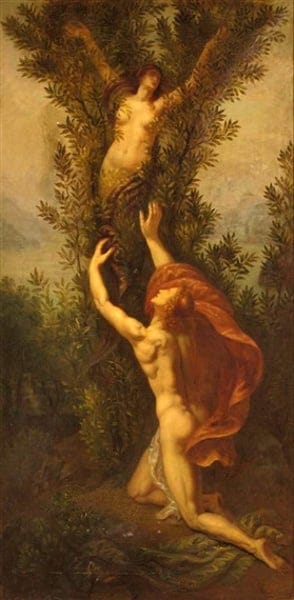
The parallels between Daphne and Eve, both fleeing, is their shared power. The women do not submit, but fight to run their own course. In turn, they rule eternal in myth, as long as astute retellers, like Milton, are able to see past the patriarchal bents into feminine rebellion and strides for power. In Paradise Lost, Milton allows for Eve to consider her fate, the allure of escape and self-transformation that Eve, like Daphne, will ultimately choose over subjection to the patriarchy.
Eve’s Submission
Adam tells Eve, as the bible commands, “God is thy law, thou mine…” This is Milton’s (and 17th-century England’s) view of sexual and marital order. Later in Book Four, Milton doubles down as Adam tells Eve, “...to know no more/ Is woman’s happiest knowledge and her praise” (4.637-638). According to Milton, in these earlier lines, Eve’s happiest state is to not seek knowledge. Which becomes ironic as Eve ultimately does choose “to know more” in her bite of forbidden fruit. But before Eve’s climactic bite, Milton, even after establishing the expectation that as a woman, she should “know no more,” allows Eve to wonder, just a few lines later: “But wherefore all night long shine these, for whom this glorious sight, when sleep hath shut all eyes?” (4.657-658). Eve asks, “But,” why the stars continue to shine, when eyes are closed at night. “But,” she inquires.
So as Milton asserts the way it should be, a woman’s contentness without seeking wisdom, “...to know no more,” he simultaneously, and antithetically, offers Eve curiosity as high and mysterious as the night sky. And this is how we conclude Book Four: with a final antithesis to Milton’s claim that Eve, and womankind, should be happiest without seeking wisdom as he allows Eve to trace the skies and consider the heights: “But wherefore all night long shine these, for whom this glorious sight, when sleep hath shut all eyes?” (4.657-658)
Eve’s Dream
In Book Five, Eve dreams, before she takes the fruit. As she sleeps, she is offered a taste of what is forbidden:
“Happy though thou art/Happier thou may’st be…
Taste this, and be henceforth among the gods,
Thyself a goddess, not to Earth confined…” (Milton 5.75-77).
The 17-century interpretation of a dream was an answer. As the bible is littered with prophets finding their answer in dreams, so did 17th-century England. So, according to this dream, is Eve’s disobedience her answer?
Either way, seeds are planted by Milton in Eve’s subconscious to defend the inevitability of her transgression. Her transgression is offered, in this dream, as an answer to Paradise’s inherent problem: an eternity without understanding. An eternity of not knowing goodness because joy is relative, and there is no context of evil.
Here Eve shows it was her fate, before Satan’s interference, to take from the fruit. That she knew there was greater happiness in knowing, in empowerment, than her blind submission in Eden, through the antithesis: “happy though thou art.” “Though” serves to offer Milton’s idea against a facade, an untrue, unreal joy. Milton presents a truth, and then counters it himself. He presents the truth he intends, and then he digs into a deeper, humanist answer, where Eve is wise and empowered. As a response, Eve mourns the taste she is given as an answer in her dream:
“But silently a gentle tear let fall
From either eye, and wiped them with her hair” (Milton 5.130-131).
Are these tears of remorse? Or tears of mourning the taste she’ll never know?
Eve’s Hunger for Knowledge
For the first time, in Book Nine, we see the silent, inward speech of Eve. In Eve, we see the awakening of “an eager appetite…Yet first/ Pausing a while, thus to herself she mused” (Milton 9.740-744). Yet, before she takes like lust or impulse, she rationally considers knowledge. Eve is explicitly wise: “...knowledge of both good and evil…but his forbidding/ Commends thee more, while it infers the good/ By thee communicated, and our want: For good unknown, sure is not had…” (Milton 9.752-756).
In “God and the Rhetoric of Sexuality,” feminist Phyllis Trible contends, “[Eve] contemplates the tree, taking into account all the possibilities. The tree is good for food; it satisfies the physical drives. It pleases the eyes; it is esthetically and emotionally desirable. Above all, it is coveted as the source of wisdom (haskil). Thus the woman is fully aware when she acts, her vision encompassing the gamut of life. She takes the fruit, and she eats. The initiative and the decision are hers alone. There is no consultation with her husband. She seeks neither his advice nor his permission. She acts independently. By contrast, the man is a silent, passive, and bland recipient…” (Trible 1982).
Milton saw what 21st-century feminist Trible saw, too. Rather than spend her days in blind allegiance and ignorance, Eve decided to take a bite of fruit. Milton, in the same vein as Trible, asserts Eve as an intellectual hero. As Eve considered the forbidden fruits before her, in Book Nine of Paradise Lost, Eve asked,
“...good unknown, sure is not had, or had
And yet unknown, is as not had at all.
In plain then, what forbids he but to know,
Forbids us good, forbids us to be wise?
Such prohibitions bind not…” (Milton 9.756-760).
This modern deconstruction of patriarchal control and Christian theology feels natural to a modern reader, yet, in its time, Milton shocks us with realization and admission of Eve’s power.
Eve’s development reveals an evolution from subordination to self-awareness and autonomy. Eve is a persuasive moral agent, undermining Milton’s claim to justify divine obedience.
Milton’s Historical Context
“Eves” are plentiful throughout creation myths: Pandora, Lilith, Psyche, Innana, Io, and Persephone (to name a few) punished for overstepping, for seeking too high, and plentiful in Milton’s allusions throughout his works.
One can find roots for the evil of women in mythmaking through Milton’s predecessors, for our early stories came to villainise the curious woman. Aristotle proclaimed before Milton: “The female is a deformity of nature, perhaps rather bad than good. Plato argued, “Men are reborn as women if they have been cowards or led unrighteous lives.” 1 Timothy 2:11-15 reads, “Let a woman learn in silence with full submission. I permit no woman to teach or to have authority over a man; she is to keep silent. For Adam was formed first, then Eve; and Adam was not deceived, but the woman was deceived and became a transgressor. Yet she will be saved through childbearing, provided they continue in faith and love and holiness, with modesty.”
And Milton, the protestant reformer, reframed Eve, out of his need to explain free will and human responsibility into a feminist argument against the voices before him. In Paradise Lost, Adam is, of course, portrayed as the nobler, morally sound hero, and Eve is largely defined by her transgression and subordination.
Yet Milton’s Adam was ready to live an eternity in ignorance, because the low hanging fruits were good enough. It was Milton’s Eve who dared to reach higher. It was Eve who gave birth to human consciousness. Milton develops Eve’s interiority as perceptive and vividly human. Milton’s Eve is remarkably capable of reasoned deliberation. She does not eat the forbidden fruit in mindless, unthinking haste. Her transgression was not empty rebellion for its own sake. It was an irrepressible urge to know. Eve was curious, hungry for more than Paradise was willing to offer.
During her pre-Fall monologue, Eve speaks persuasively and logically. She challenges the assumptions of Paradise. Her decision to separate is intellectually defensible. Her disobedience is reasoned, not rash. After the Fall, Eve is rewarded. Her language is elevated. She is moral. Her voice is stronger, more persuasive:
“Greatly instructed I shall hence depart,
Greatly in peace of thought, and have my fill
Of knowledge, what this vessel can contain…” (Milton 12.557-559).
Milton rewards Eve not with innocence, but with eloquence born of experience. Disobedience rewarded her. Her departure from Eden is mature, wise, and balanced.
Proto-Feminist Conclusion
In Paradise Lost, amidst the classical story of Original Sin, Eve rightfully hungers for knowledge, questions, and stories on her quest to experience a life of meaning. Milton was a poet, an intellectual, and a man who himself defied kings and popes. In Paradise Lost, through antithesis against the professed, expected beliefs of his time, Milton allowed Eve her boldness despite 17th-century England’s divine authority.
Through the development of Eve’s agency across the poem, Milton presents a compelling argument in favor of questioning, and resisting, obedience. In the end, John Milton’s Paradise Lost, the mother narrative of modern English fiction, simultaneously upholds 17th-century patriarchal norms and challenges them. Paradise Lost, in the end, is a ground-breaking narrative brimming with proto-feminist ideas in Milton’s deep, humanist characterization of Eve.